
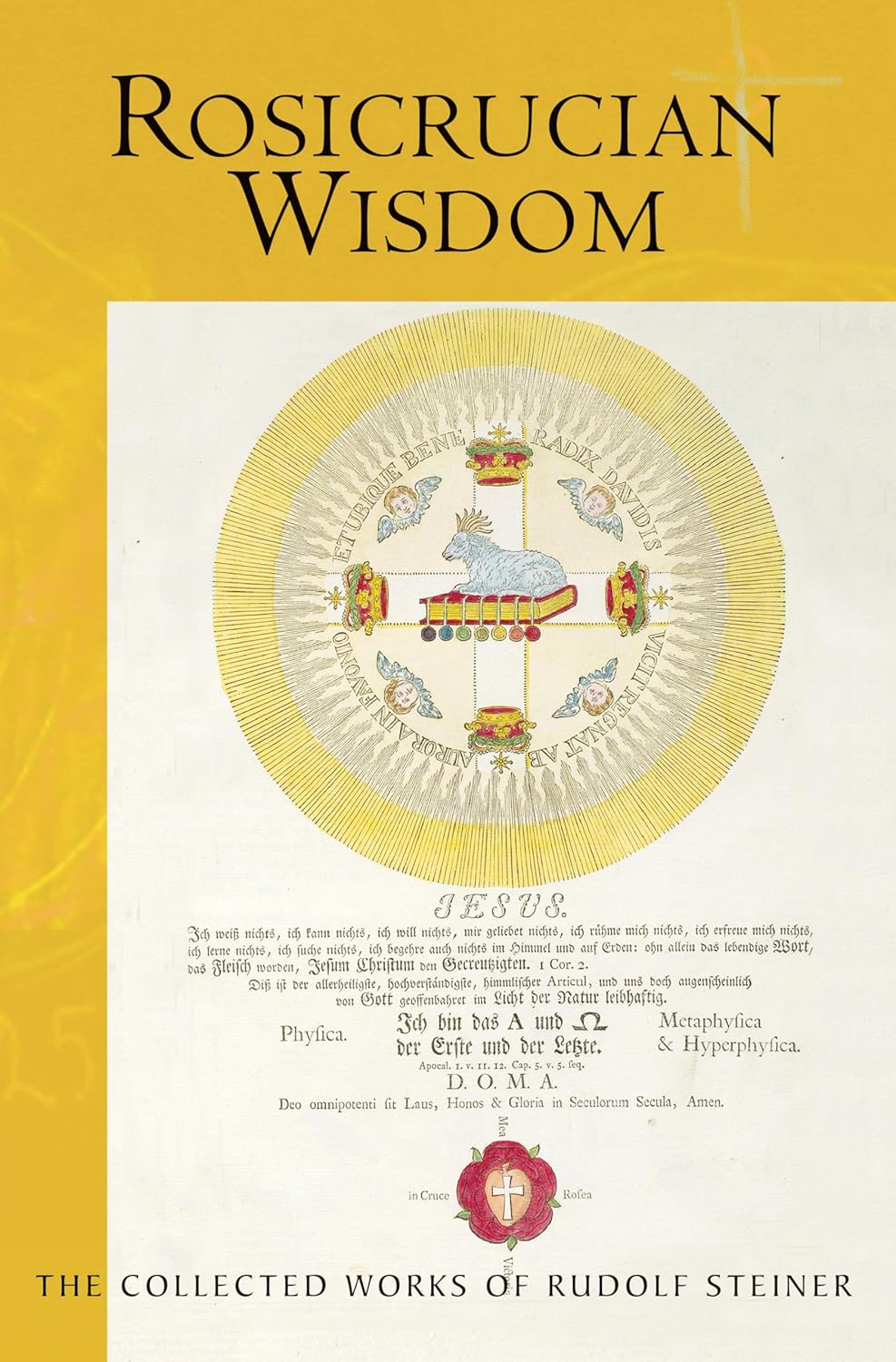


Rosicrucian Wisdom
Fourteen lectures May–June 1907, Munich (CW 99)
These inspirational lectures offer a compelling introduction to a modern path of spiritual development rooted in esoteric Christianity. Rather than drawing solely from historical traditions, Steiner presents a renewed spiritual science – anthroposophy – based on firsthand research.
Rudolf Steiner outlines the Rosicrucian path as a spiritual approach suited to the consciousness of our time – one that engages both the heart and the intellect while remaining deeply practical. He guides us through seven stages of initiation, exploring the evolution of human consciousness, karma, reincarnation, and the hidden dimensions of Christian mysteries. At the center of this path lies a profound understanding of Christ as a cosmic being, whose sacrifice at Golgotha represents a pivotal moment in both human and cosmic history.
Steiner emphasizes that spiritual knowledge should not remain abstract or purely contemplative. Instead, it should enter into daily life, transforming thought, feeling and action. He discusses essential spiritual truths including the law of destiny, life after death, and methods for developing spiritual vision. Themes such as spiritual alchemy and the Philosopher’s Stone are presented with clarity and insight.
This powerful series of lectures is widely regarded as one of Steiner’s most concise presentations of his esoteric worldview. The new revised edition includes an introduction by Brien Masters, editorial notes and an index.
C O N T E N T S
Introduction, by Brien Masters
Lecture 1
Munich, 22 May 1907
The New Form of Wisdom
Lecture 2
Munich, 25 May 1907
The Ninefold Constitution of the Human Being
Lecture 3
Munich, 26 May 1907
The Elemental World and the Heaven-World. Waking Life, Sleep and Death
Lecture 4
Munich, 28 May 1907
Descent to a New Birth
Lecture 5
Munich, 29 May 1907
Communal Life between Death and a New Birth into the Physical World
Lecture 6
Munich, 30 May 1907
The Law of Destiny
Lecture 7
Munich, 31 May 1907
The Technique of Karma
Lecture 8
Munich, 1 June 1907
Human Consciousness in the Seven Planetary Incarnations
Lecture 9
Munich, 2 June 1907
Planetary Evolution I
Lecture 10
Munich, 3 June 1907
Planetary Evolution II
Lecture 11
Munich, 4 June 1907
The Evolution of Humanity on the Earth I
Lecture 12
Munich, 4 June 1907
The Evolution of Humanity on the Earth II
Lecture 13
Munich, 5 June 1907
The Future of Humanity
Lecture 14
Munich, 6 June 1907
The Nature of Initiation
Notes
Rudolf Steiner’s Collected Works
Significant Events in the Life of Rudolf Steiner
Index
About the Author
Rudolf Steiner (b. Rudolf Joseph Lorenz Steiner, 1861–1925) was born in the small village of Kraljevec, Austro-Hungarian Empire (now in Croatia), where he grew up. As a young man, he lived in Weimar and Berlin, where he became a well-published scientific, literary, and philosophical scholar, known especially for his work with Goethe’s scientific writings. At the beginning of the twentieth century, he began to develop his early philosophical principles into an approach to systematic research into psychological and spiritual phenomena. Formally beginning his spiritual teaching career under the auspices of the Theosophical Society, Steiner came to use the term Anthroposophy (and spiritual science) for his philosophy, spiritual research, and findings. The influence of Steiner’s multifaceted genius has led to innovative and holistic approaches in medicine, various therapies, philosophy, religious renewal, Waldorf education, education for special needs, threefold economics, biodynamic agriculture, Goethean science, architecture, and the arts of drama, speech, and eurythmy. In 1924, Rudolf Steiner founded the General Anthroposophical Society, which today has branches throughout the world. He died in Dornach, Switzerland.




Reviews
There are no reviews yet